How To Order Guitar/Bass Pedals (Ultimate Signal Flow Guide)


So you've picked up some awesome effects pedals for your rig and want to get the most out of them. Understanding signal flow and placing pedals in the proper order will lead to optimal performance.
So how should we order our guitar (or bass) pedals for optimal signal flow? Though there are no hard rules in music and art, the typical order of guitar effects pedals for optimal signal flow is as follows:
- Utility Pedals: tuners, buffers, and switcher pedals.
- Dynamics pedals: compressors, filters, pitch shifters, and volume pedals.
- Gain-based pedals: boost, overdrive, distortion and fuzz pedals.
- Modulation effects pedals: chorus, flanger, phaser and other modulation pedals.
- Time-based effects pedals: delay and reverb pedals
*Volume pedals can go anywhere in the effects chain.
In this article, we'll have a look at signal flow in detail. We'll also discuss the different pedal types and why certain effects should be stacked according to the “optimal” order listed above. Finally, we'll have a look at a few real-world examples of pedalboards and critique the signal flow.
Related My New Microphone articles:
• The Ultimate Effects Pedal/Stompbox Buyer’s Guide
• Top 11 Best Guitar/Bass Effects Pedal Brands To Know & Use
If you'd like to support my work and learn more about music production, please consider subscribing to my Substack.
Table Of Contents
- What Is Signal Flow?
- A Note On True Bypass
- The Optimal Order Of Effects Pedals
- Utility Pedals
- Synth Pedals
- Dynamics, EQ & Pitch-Shifting Pedals
- Gain-Based Pedals
- Modulation Pedals
- Time-Based Effects Pedals
- Looper Pedals
- Volume Pedals
- Real-World Pedal Board Examples
- Organizing Your Own Pedalboard
- Related Questions
What Is Signal Flow?
Signal flow, as the name suggests, refers to the path and direction in which an audio signal (or another signal type) flows within a system.
Analog audio signals, like those outputted from a guitar pickup, are measured as AC voltages. These signals, then, move electrons back and forth within a circuit (made of guitars, cables, pedals, amplifiers, etc.).
Although the electric current (the flow of electrons) is alternating, the audio signal is envisioned as having a single direction.
There are a few key points to understand about signal flow:
- A signal will flow from an output to an input.
- Signals can be split and sent through multiple paths.
- Signals can be consolidated into a single path.
Other factors that come into play when dealing with signal flow are:
- Unbalanced cables (guitar patch cables) have distributed capacitance. This means longer cable runs will degrade the high-end (treble) of the signal.
- For optimal signal transfer, the load (input) impedance of a device should be much greater (ideally >10x) the source (output) impedance of the device before it.
- A signal processing unit (like a guitar pedal) will affect the signal at its input and is, therefore, affected by everything before it in the signal chain.
So, when dealing with a series of pedals, it's important to understand signal flow.
A solid comprehension of signal flow will help tremendously in getting the most out of our effects pedals, guitars and amplifiers.
A Note On True Bypass
You may notice that some of your pedals are “true bypass”. This can be a good or bad thing when connecting several pedals in series!
Related article: Is It Bad/Damaging To Keep Effects Pedals On Or Plugged In?
What is true bypass? True bypass is a switching circuit that will route the guitar signal directly from the input to the output when the pedal is turned off. A pedal with true bypass, then, will effectively act as an extension of the guitar cable when turned off and have little to no effect on signal tone/degradation.
True bypass pedals are distinguishable from their buffered bypass counterparts in one major way:
When bypassed, the true bypass circuit sends the signal from input to output with little to no colouration of tone or change in impedance. The buffered bypass circuit still sends the signal through the pedal's circuit, only without triggering the effect.
The signal passes relatively “untouched” through a true bypass pedal in off position. Conversely, the signal passing through a buffered bypass pedal in off position will still be processed, only without the intended effect.
This buffer processing includes conversion of impedance, some amount of potential gain, and, as expected, some change in tone.
So the benefit of true bypass is that the tone will remain unchanged when the pedal is off. However, true bypass pedals will effectively lengthen the
The benefit of buffered bypass is that the signal will still be buffered even when the pedal is off.
To learn more about True Bypass pedals, check out my article What Does ‘True Bypass’ Mean In A Guitar Pedal?
When dealing with lots of pedals and/or long cable runs, a mixture of true bypass and buffered bypass pedals is likely the best bet.
The Optimal Order Of Effects Pedals
Generally speaking, the optimal order of effects pedals is as follows:
- Utility Pedals
- Synth Pedals
- Dynamics, EQ & Pitch-Shifting Pedals
- Gain-Based Pedals
- Modulation Pedals
- Time-Based Effects Pedals
- Volume Pedals
- Looper Pedals
Let's go over a few key principles we should understand about signal flow to help us understand this “optimal order” and to help us choose which pedals should go before or after others in real-world situations.
Remembering our discussion on signal flow, we know that the guitar signal will flow from the guitar's pick up to the first pedal, followed by the second pedal, third pedal, fourth and so on before reaching the guitar amplifier.
Any pedal on the board will affect the signal at its input and, therefore, the signal that is affected by each pedal before it. For this reason, utility pedals, gain-based pedals, dynamics pedals, and synth pedals work best at the beginning of the chain.
For instance, we wouldn't want a chorus pedal (which modulates the signal by duplicating it and detuning it) before our tuner pedal.
Similarly, we wouldn't necessarily want a reverb pedal before a synth pedal, which optimally acts to convert a dry guitar signal into a synth patch.
Another example of “improper” ordering would be to put a delay pedal before a fuzz pedal. Of course, the results could be cool, but in principle, the fuzz pedal, which really distorts its input signal, would really muddy up the delay tails with the dry signal and cause a cacophony of fuzz noise.
Now, I'm not saying we should never experiment outside of the “optimal” order. Music is about getting creative, and experimenting with different sounds and pedal orders is one way of getting creative. What I am saying, however, is that in general, the above order will yield the most natural, clean and controllable sounds from a pedalboard.
When it comes to real-world pedals, it's important to have strong and full-spectrum signal flow throughout the system.
This means that cable lengths should be kept to a minimum, and perhaps a mixture of true bypass and buffered bypass pedals should be used.
In addition to this, the pedals should be compatible load (input) and source (output) impedances to drive the following pedal or amplifier properly and to be driven by the preceding pedal or guitar properly.
If the signal becomes weak at any point in the signal chain, a buffer pedal can be used to strengthen the signal.
Related article: How Many Guitar Effect Pedals Is Too Many?
With that, let's have a closer look at each pedal effect type (and each sub-type) and how they should be ordered in a pedalboard chain.
Utility Pedals
Utility pedals are essentially effects pedals that are designed not to affect the signal with a particular effect. Rather, they are designed to tell us information about the signal, route the signal, or aid in strengthening the signal without altering the tone.
Since utility pedals do not alter the tone (ideally) of the signal, they are typically positioned best at the front of the signal chain. This way, they receive the raw signal from the guitar pickup (or the signal after only a pedal or two) and can effectively do their job on a relatively clean signal.
Utility pedals include:
Tuner Pedals
As the name suggests, tuner pedals help us tune our instruments by reading the frequencies of the inputted signal as musical notes.
Tuner pedals work best at the start of a pedalboard, reading and reacting to an unprocessed signal from the guitar.
Tuner pedal example: TC Electronic PolyTune 3
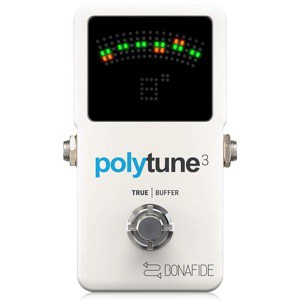
TC Electronic
TC Electronic is featured in My New Microphone's Top 11 Best Guitar/Bass Effects Pedal Brands To Know & Use.
Line-Switching Pedals
Line-switching pedals, often referred to as AB or ABY pedals, act as routing points in a signal chain.
A line-switching pedal can be set to send its input signal through multiple signal chains, either one at a time or several at once.
With a line-switcher, we can effectively turn multiple pedals on or with a single stomp (rather than a fast tap-dancing maneuver) by altering the signal path to a new line of pedals.
Note that line-switchers do not necessarily have to be at the front of the pedalboard but often have more of an effect when they control longer chains of pedals from their outputs.
Line-switcher pedal example: Boss LS-2 Line Selector
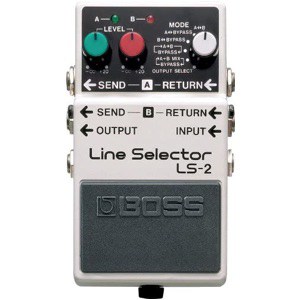
Boss
Boss is featured in My New Microphone's Top 11 Best Guitar/Bass Effects Pedal Brands To Know & Use.
To learn more about switcher pedals, check out my article What Is A Guitar Pedal Switcher & How Do Switchers Work?
Buffer Pedals
A buffer pedal acts as an impedance converter (and sometimes as a boost). These pedals work to combat the low-pass filter effects due to the capacitance of long cable runs and low-input impedance and high-output impedance pedals.
Buffer pedals often work best at the beginning of the pedal chain, helping to rid of the capacitive effects of the guitar patch cable between the guitar and the first pedal.
They also tend to work well at the end of a pedalboard, helping to drive the amplifier.
Buffer pedals can also be positioned near pedals with weaker electronics, low input impedance, or high output impedance.
Buffer pedal example: JHS Little Black Buffer

JHS Pedals
JHS Pedals is featured in My New Microphone's Top 11 Best Boutique Guitar/Bass Pedal Brands To Know & Use.
For more information on buffer pedals, check out my article Are Buffer Pedals Necessary & Where Do They Go In A Chain?
Volume Pedals
Volume pedals can be put at the front of a pedalboard but are often put at the end of the pedal. Actually, volume pedals can be put anywhere, really. We'll discuss volume pedals in more detail in a later section.
Synth Pedals
Synth pedals fundamentally alter the shape of the guitar input signal.
Guitar synth pedals are designed to convert guitar pickup signals into synth waveforms. Bass synth pedals are designed to convert bass guitar pickup signals into synth waveforms.
Then, it stands to reason that these synth pedals would work best at the beginning of the pedal chain since the guitar signal will be less processed.
That is not to say that cool results are not possible when chaining a synth pedal after another pedal. However, these pedals are designed to act on a clean guitar signal and, therefore, work best near the front of the signal chain.
Synth pedal example: Source Audio C4

Source Audio
Source Audio is featured in My New Microphone's Top 11 Best Guitar/Bass Effects Pedal Brands To Know & Use.
To learn more about synth pedals, check out my article What Are Synth Pedals (Guitar/Bass FX) & How Do They Work?
Dynamics, EQ, & Pitch-Shifting Pedals
So utility and synth pedals are typically best when positioned at the front of the pedal chain. As mentioned, these pedals either measure the signal, strengthen the signal, or fundamentally alter the signal.
Once the guitar (or bass) signal passes through the pedals mentioned above, the basic dynamic and equalizing processing pedals should follow along with any pitch-shifting effects.
I've listed these three main effects groups together since there's really no absolute right or wrong answer here. These pedals lead us to the same fundamental mixing question of whether to compress before or after EQ.
Personally, I'm of the school of EQ into compression into pitch-shifting, but that's my own preference. Play around to find what sounds best to you and what is most easy to control.
The dynamic pedals we'll discuss here are compressors, limiters, expanders, and noise gates.
EQ pedals include envelope filters, EQs, and wah pedals.
We'll also discuss pitch-shifters and harmonizers.
Compressor & Limiter Pedals
Compressors act to reduce the dynamic range of an input signal by attenuating the amplitude peaks within the signal.
If the signal surpasses a set threshold, the compressor kicks in to reduce the amplitude above the set threshold by a defined ratio. As an example, a 4:1 ratio would mean that for every 4 dB the input signal goes above the threshold; the output signal would only go 1 dB above the threshold.
To learn more about dB (decibels), check out my article What Are Decibels? The Ultimate dB Guide For Audio & Sound.
Make-up gain is typically used to bring the level of the signal back up to pre-compression peak levels.
The sonic results of compression range wildly. Compression is often used to thicken up a sound and is particularly effective on bass guitar. When a signal is over-compression, saturation and distortion can alter the sonic character of the sound.
Limiters are essentially hard compressors. Whereas a compressor will attenuate above a given threshold, a limiter will completely stop/limit the signal from surpassing a certain threshold ceiling.
If we draw a comparison between compression/limiting and distortion, we can say that compression is analog to soft-clipping (overdrive-style distortion) while limiting is more similar to hard-clipping distortion (of which many distortion and all fuzz pedals are based on).
Compressor pedal example: Boss CS-3

Limiter pedal example: Boss LMB-3
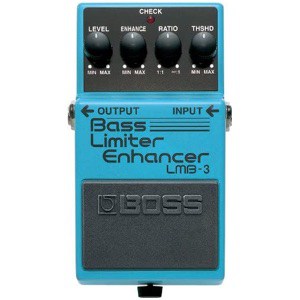
For more information on compressor pedals, check out my article What Are Compressor Pedals (Guitar/Bass) & How Do They Work?
Expander Pedals
Expansion, in audio, is the opposite of compression by expanding the dynamic range of a signal.
This effect will drop a signal below a set threshold by a given ratio. For example, a ratio of 2:1 would mean that for every 1 dB an input signal drops below the threshold, the output signal will be 2 dB below said threshold.
Expansion is much less common in audio than compression, which is seen in the lack of expander pedals on the market (and the abundance of compressor pedals). That being said, they are worth mentioning here.
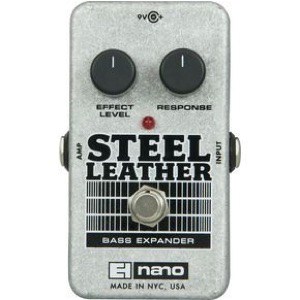
Expander pedal examples: Electro-Harmonix Steel Leather